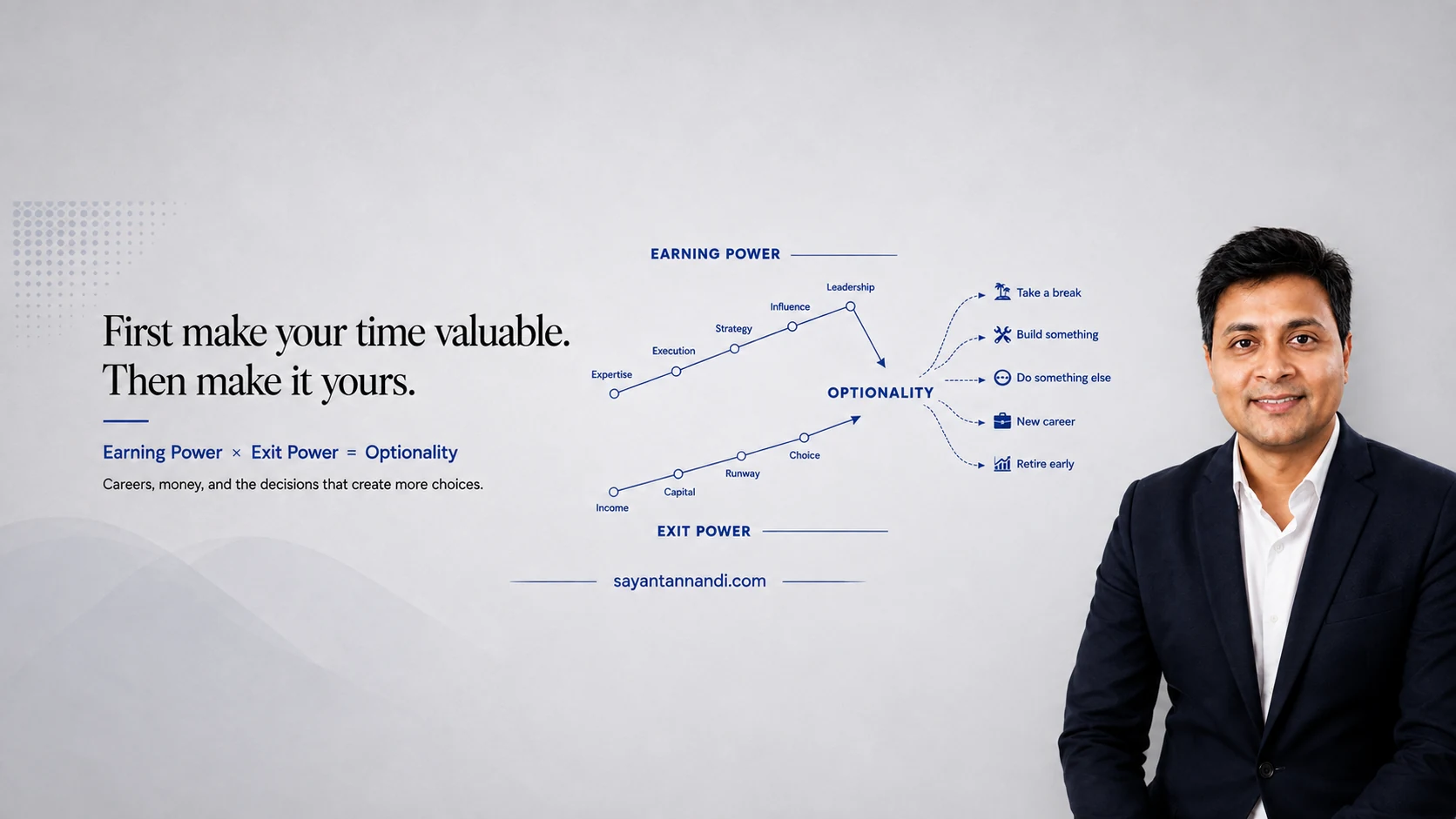
The philosophyFirst make your time valuable.
Then make it yours.
Build the capability to earn more. Learn how money works. Decide what both should make possible.
My work connects career ambition with financial judgment. Earning power is the ability to earn from capabilities people value. Exit power is the room to change your working arrangements without needing the next salary to arrive exactly as planned.
The beliefs behind our decisionsHard work needs a direction.
Many of us learned to trust a familiar sequence: study hard, find a good job, become dependable and keep moving up. There were practical reasons for that advice. A regular salary could change a family’s access to housing, education and care. I take those benefits seriously.
The difficulty comes when the same instruction is asked to solve every later problem.
More effort can improve the work you already do without preparing you for a role with different responsibilities. An excellent specialist may need practice making decisions across teams. Someone known for rescuing projects may need to build a system that needs fewer rescues. The work remains demanding, but the contribution changes. A longer task list does not explain whether that change has happened.
Agreement is not the only form of contribution.
Respect for experience can help a team learn. Treating every disagreement as disrespect can leave a weak assumption untouched. A manager who sees a capacity problem needs to explain it while there is still time to change the plan.
“We can deliver the customer release on Friday if we move the internal dashboard to Tuesday. Keeping both on Friday would remove the testing time. I recommend protecting the release.” That response gives the other person a decision to make. It does not guarantee agreement, but it makes the consequence visible without attacking anyone.
Education, family expectations and workplace experience can all influence these habits. Indian professionals have diverse experiences of each. The useful question is which habit you carry into a situation, and whether it still helps you do the work.
Expertise needs somewhere to travel.
Technical depth matters. Its value can grow when you understand the decision around it. Explaining how a system failure affects a customer, a payment or a deadline helps another person judge what to do. That is business involvement in an ordinary working day.
Leadership is one route to greater earning power. Deep specialist work can be another. A global title or a move abroad also needs examination: the location does not tell you how much authority the role carries or what the household will give up to take it.
A raise does not decide what to do with it.
A more expensive home, a bigger car or a move abroad can become the expected next step before the household has compared the choices. Someone else’s purchase tells you little about their resources or obligations. It cannot settle what you can comfortably commit to.
Learning about money is part of the work too: understanding borrowing costs, distinguishing income from assets, identifying accessible resources and seeing how recurring commitments affect future decisions.
A simple illustration. Suppose monthly take-home pay rises by ₹50,000 and new monthly commitments rise by ₹40,000. The increase leaves ₹10,000 before any other changes in spending. The higher salary is real. How much flexibility it adds depends on what happens to it.
These are fictional figures. They show an exchange to examine, not a spending rule.
A larger home may make family life easier. A holiday may be worth far more to you than another month of saving. The point is to see the exchange clearly, including the recurring costs that make a future change harder. Choosing comfort today can be sensible. Discovering that every raise has already become a commitment is a different experience.
A good financial decision supports something you value. Accumulating the largest possible balance is not the only aim.
The two powers develop alongside each other.
You can improve a leadership skill while reviewing the commitments attached to your salary. You can retain more of a pay rise while deciding which experience would make your next role more valuable. There is no requirement to finish a career before asking what it is for.
My current teaching concentrates on earning power. The Step Up to Senior Leadership develops twelve practical skills across six weeks. The cohort follows the same curriculum with scheduled live sessions and feedback on defined submissions. The course teaches leadership skills; it does not teach investing or household financial planning. Promotion and pay still depend on opportunity and the employer’s decision.
Exit Power explores the financial and practical side of choice. The Optional Career brings both parts into the same conversation.
The decisions remain personal: which responsibilities you want to take on, and which commitments deserve the future time they require.